
Monroe 24-Hour Release Fallback
The official Monroe County Correctional Facility page provides facility contacts and policies, but it does not expose a current roster or a list of people released today. A review of the Monroe County sitemap also found no public release-report endpoint. As a result, there is no county source from which to quote a rolling window, update schedule, archive period, photograph flag, or set of displayed fields. Communications and deposit services named in jail materials are not public release lists.
The official fallback begins with MCCF. Ask whether the named person is still confined and which records channel can confirm the final event. If the person is no longer at MCCF, the key fact is the custody disposition. A release to the community is not the same as a transfer to the Pennsylvania Department of Corrections, another county, federal custody, or immigration custody. The jail's dated departure record is the best local evidence of what physically happened. A court docket can then explain the order behind it.
Check Monroe 24-Hour Releases
A same-day check should move from the former custodian to the legal record, then to any receiving system. This order prevents a missing jail name from being mistaken for community release. MCCF lists 570-597-3764 as its current main telephone number and publishes weekday business hours. Staff may be able to answer the narrow current-custody question or direct the caller to the right records office. Oral access can be limited, so a written request remains the stronger route when a precise time and disposition matter.
- Call MCCF and ask whether the person remains confined. Give enough identity information to avoid a name-only mismatch.
- If the person has left, ask which office maintains the release or transfer entry and whether the destination can be disclosed.
- Submit the county's Standard RTKL Request Form for the dated existing record when telephone confirmation is not enough.
- Compare the response with the Pennsylvania UJS criminal docket for bail, dismissal, sentence, parole, or transfer-related orders.
- Follow the receiving agency named by MCCF. Use PA DOC for a state transfer, BOP for a federal case, and ICE ODLS for an immigration transfer.
For a broad same-day browse, these steps must be repeated for each known person because Monroe County offers no county-wide list. For a single named person, the fuller Monroe County released-inmate search path brings the jail, court, state, and notification sources together. Search dates carefully. A court order entered today may precede the jail's physical discharge work, while the jail record may use a later time.
Note: The Monroe County 72-Hour Releases route uses a wider court-and-record window when the same-day check is too narrow.
Request Monroe Release Fields
There is no public Monroe County 24-hour release table to read. Nor has the county published a data dictionary for its internal release record. The fields below are therefore items to request where MCCF maintains them. They are not a claim that every record contains each item. Use the person's full name, date of birth or jail identifier if known, MCCF as the facility, and a narrow date range. Ask for records sufficient to show the event, not for staff to answer a research question.
| Requested field | What it can establish |
|---|---|
| Name and identifier | Connects the event to the correct booking and reduces mistaken identity. |
| Admission date and time | Defines the custody episode tied to the requested departure. |
| Release or transfer date and time | Shows when MCCF recorded the physical end of that custody episode. |
| Release type or disposition | Separates bond, recognizance, time served, county parole, dismissal, sentence completion, and transfer. |
| Authorizing court or order | Links the jail action to a judicial source when that field is maintained. |
| Receiving agency or hold result | Shows whether custody continued with PA DOC, another county, BOP, ICE, or another custodian. |
The county's records form asks for the receiving agency, requester's contact information, a subject and time frame, the record type, the desired medium, a certification choice, and a fee-notification threshold. Electronic delivery can reduce handling. Monroe County's RTKL policy says a written request addressed to its Open Records Officer preserves the law's response and appeal remedies. The reviewed sources do not state an ordinary retention period for MCCF release logs, so an old record's availability must be confirmed by the county.
Monroe Bail Releases Start Locally
A person who leaves MCCF on bail has not completed the criminal case. Monroe County's nine Magisterial District Judges conduct preliminary arraignments and fix and accept bail. That makes the MDJ docket a useful same-day source for the court event that may authorize release. It does not replace the jail's departure entry. Bail can be posted, reduced, or changed while MCCF still has processing to complete, and another valid hold may prevent community release.
The county Public Defender's criminal-procedure material explains that a represented person may request a bail-reduction form and that counsel can file the request after it is returned. A request is not an order. Likewise, a docket entry showing bail terms is not proof that bail was posted or that all holds cleared. Read the bail section and chronological entries together, then obtain MCCF's recorded disposition. If charges are held for court, later entries move to the Court of Common Pleas level, so a name search may require both judicial levels.
- Bond release
- A court-authorized community departure after the required bail condition is met, subject to other holds.
- Recognizance release
- A release based on a promise to appear rather than a cash payment, when ordered by the court.
- Transfer
- A move from MCCF to another custodian. It is not release into the community.
- Time served
- A sentence or disposition crediting confinement already completed, though jail processing and other holds still matter.
Note: A judicial release order and MCCF's door-out time are separate events, so compare the docket with the jail record.
Monroe Same-Day Custody Paths
Different systems answer different same-day questions. The MCCF record shows departure from the county facility. The UJS docket shows legal events such as bail, dismissal, disposition, sentence, and later orders. PA SAVIN and VINELink can deliver custody-status notices for participating county jails, state prisons, and state parole, but a notice must be read as the event it names. A transfer alert is not a release alert. No notification service should be the only source when the exact outcome matters.
| Situation | Correct Monroe release check | Meaning |
|---|---|---|
| Still at MCCF | MCCF custody confirmation | The person remains in county custody, regardless of a pending court order. |
| Left MCCF for the community | MCCF release record plus UJS docket | The dated disposition should name the basis for community release. |
| Transferred to state custody | MCCF transfer record plus PA DOC Inmate Locator | The person left the county jail but remains confined under state jurisdiction. |
| On state parole | PA DOC supervised-individual locator and Board record | The person is in the community under state supervision, not finally discharged. |
| Federal or immigration transfer | BOP locator or ICE ODLS after MCCF identifies the destination | County custody ended, but another federal system may continue custody. |
The PA DOC locator has separate inmate and supervised-individual searches. The inmate side covers people under current DOC jurisdiction. The supervised side covers people now under DOC community supervision and includes Release Date as a past-date search field. It is not a future projection and not a permanent archive of all discharged people.
The official PA DOC locator view shows how state custody and current supervision are split into two searches.
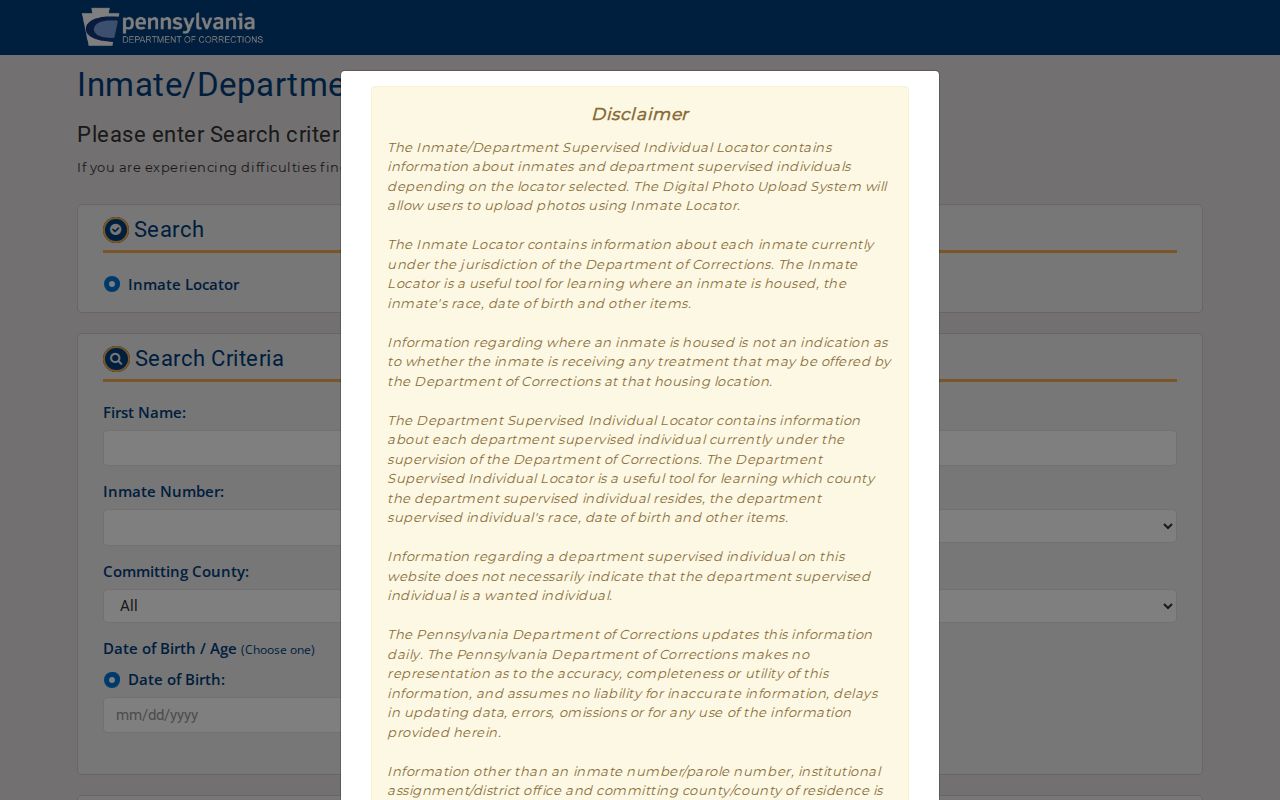
This state screen becomes relevant only after the Monroe County release record points to PA DOC custody or state parole.
Monroe Feed Window Is Undocumented
Monroe County's official correctional navigation and complete sitemap expose no release report or public archive. That means there is no factual basis for claiming that a name remains visible for one day, disappears at midnight, refreshes on a set cadence, includes a booking image, or stays available for later review. The absence is about online publication. It does not mean MCCF creates no internal admission, commitment, release, or transfer record.
For recent events, contact MCCF first. For a durable response, send a focused written request through Monroe County Open Records. A useful request seeks the date, time, and custody disposition for a named booking within a bounded range, including the responsive release or commitment-log entry. Ask for the receiving agency when the event was a transfer. The county may produce records, redact protected parts, issue a partial or full denial with a legal basis, or report that no responsive record is maintained.
Older same-day questions often depend more on persistent sources. Search both the Magisterial District Court and Common Pleas levels in the UJS Portal. Then use the former custodian's archived record or a state, federal, or immigration record when the docket identifies that path. Public docket absence can result from limited access, sealing, expungement, juvenile rules, record destruction, or a search mismatch. It must not be translated into proof of release.