
Monroe County Parole Versus Probation
Parole and probation both allow a person to live in the community under rules, but they start in different ways. Parole is conditional release during an unexpired sentence. It may follow a state prison term or, in some Monroe County cases, a county sentence. Probation is a court-ordered form of supervision that can be imposed instead of confinement or as part of a sentence. Neither term means the case or sentence has vanished. The responsible office depends on the sentencing order, sentence length, place of confinement, and any exception that applies.
Monroe County Public Defender guidance offers a local rule of thumb. The county sentencing judge generally controls parole when aggregate maximum sentences are below twenty-four months. State parole generally applies when the maximum is two years or more, with a described exception for some county DUI sentences. That summary helps route a question, but the actual sentencing order controls. Aggregate means combined terms treated together. A transfer to PA DOC also changes the record path.
| Supervision type | How it begins | Primary verification route |
|---|---|---|
| County probation | Ordered by the Monroe County Court of Common Pleas | Adult Probation and the court docket |
| County parole | Conditional release under county sentencing authority | Sentencing court, Adult Probation, and release record |
| State parole | Parole Board release from a PA DOC sentence | PA DOC supervised-individual search and final Board Action |
| Discharge | Supervision and the controlling sentence have lawfully ended | Final court, Board, or DOC record |
- Parole
- Conditional community release while part of a sentence remains.
- Probation
- Court supervision imposed as a sentence or part of one.
- Discharge
- The formal end of the relevant supervision obligation.
- Recommitment
- A return to custody after a parole decision based on a violation or new conviction.
Verify Monroe County Post-Release Supervision
Start with the sentence, not an assumption based on where the person now lives. PA DOC operates two distinct public searches. The inmate side covers people currently under state correctional jurisdiction. The Department Supervised Individual side covers people currently under PA DOC supervision in the community. Its fields include name, inmate or parole number, county of residence, district office, gender, release date, and birth date or age. A matching supervised-person record supports active state oversight and identifies the district office. It is not a permanent archive of all former parolees.
County probation and county parole do not fall under general PA DOC control. Monroe County Adult Probation is part of the Court of Common Pleas. Search the official docket to identify the sentence, then contact the county office when the order points to local supervision. When a complete release trail is also needed, the Monroe County released inmate search explains how MCCF, court, and transfer records fit together.
- Confirm the full name and another identifier, such as date of birth, DOC number, or parole number.
- Read the sentencing docket and determine whether the matter is county probation, county parole, or a PA DOC sentence.
- For state parole, search the Department Supervised Individual tab and use the district office returned by the record.
- For county supervision, contact Monroe County Adult Probation and cite the docket or case number.
- If supervision may have ended, obtain the final Board, DOC, or court discharge record. Do not treat a missing search result as proof.
Important: A PA DOC supervised-person entry does not necessarily mean that the person is wanted.
PA DOC says its locator information is updated daily. Even so, names can be shared and status changes can lag. Compare the DOC or parole number, birth details, county, and office before relying on the match. For county cases, the docket can show the supervision sentence and later orders, but the local office remains the direct source for current reporting status.
PA SAVIN through VINELink adds release, transfer, movement, and state-parole notifications. An alert records the event supplied by the participating agency, not final discharge. Use the locator, Board Action, or county court record to verify the continuing supervision status.
See the official PA DOC parole office directory for how state assignments work. The screenshot below shows the statewide office lookup used after a state-supervision result identifies the correct district.
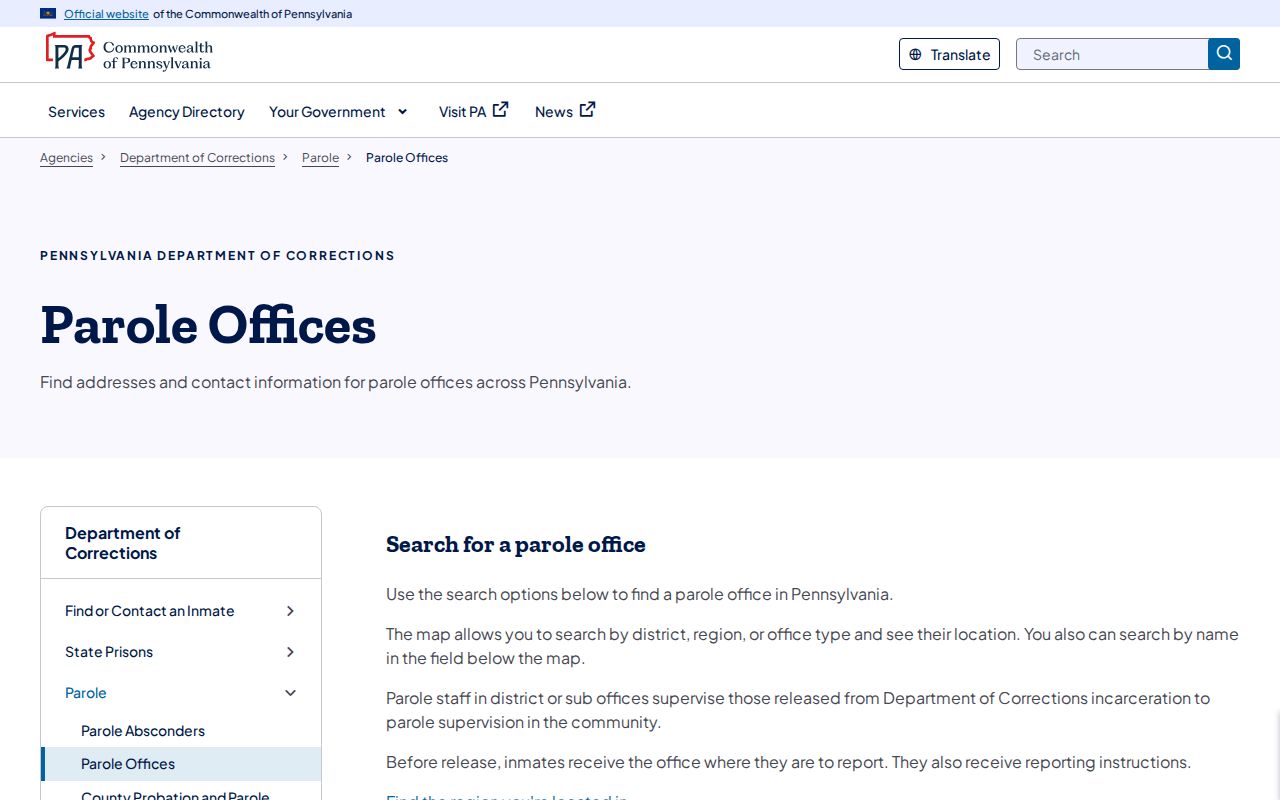
The returned district office, not Monroe County residence alone, should guide contact because specialized and interstate supervision can change the assignment.
Note: Search the county court office for county supervision and the PA DOC locator for active state supervision.
Monroe County Probation Office Details
Monroe County has a specific local office for county probation and parole questions. The county court page is the preferred current source because it lists a different phone and fax from the PA DOC county-office directory. The office is not the automatic contact for a person released from state prison. State parolees should use their assigned PA DOC district office and reporting instructions.
Monroe County Adult Probation
Monroe County Courthouse
610 Monroe Street
Stroudsburg, PA 18360
Phone: 570-517-3098
Fax: 570-517-3869
8:30 a.m. to 4:30 p.m., Monday through Friday
Closed major holidays
Secondary Official Listing
Suite 221
610 Monroe Street
Stroudsburg, PA 18360
Phone: 570-517-3095
Fax: 570-420-3707
The PA DOC county directory supplies these numbers. Use the county court listing first.
Give staff enough detail to distinguish people with similar names. A docket number is useful. Ask whether the office can confirm the type of county supervision or direct the inquiry to the record custodian. Staff may limit what can be disclosed, and an office contact is not a substitute for a certified court order.
Monroe County State Parole Decisions
State parole is not automatic at the minimum sentence date. Under Pennsylvania law, the minimum ordinarily marks the first point when the Parole Board may act. The Board weighs the offense, recommendations, prison conduct, record, programming, victim material, and other statutory factors. A grant is conditional. Home-plan approval, testing, programming, detainers, or other terms in the decision can delay physical departure.
There is no public person-by-person calendar with exact parole interview dates. Institutional parole staff provide the date to the incarcerated person. A later review shown in a Board Action may state only a month and year. It is a review point, not a promised release date. The Pennsylvania Board of Pardons calendar is for clemency matters and must not be confused with the ordinary Parole Board process.
The official parole interview page shows the eligibility and decision factors used by the Board.
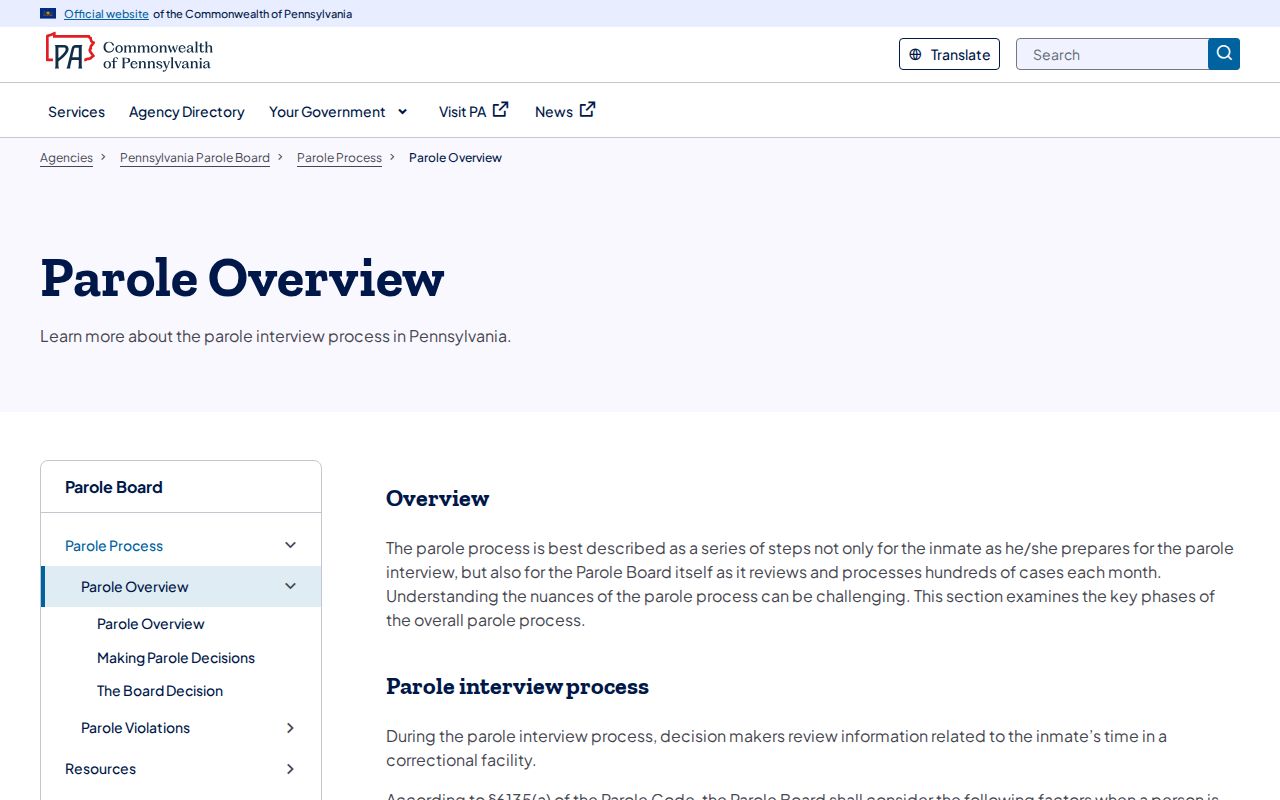
Those factors explain why reaching a minimum date does not establish that a Monroe County person has been released.
A final Board Action is the decision record. It becomes public after the subject receives a copy. Ask the subject for it, use the Board decision contact, or submit a focused request through the Parole Board Right-to-Know page. The request office is at 1101 South Front Street, Suite 5100, Harrisburg, PA 17104-2521, and accepts email at RA-pbpprighttoknow@pa.gov during posted weekday office hours.
Note: A favorable Board Action starts a release process; it does not prove the person left prison that day.
Monroe County Supervision Violations
A violation can produce more than one outcome. State preliminary proceedings may continue parole or detain the person for a later violation hearing. A revocation decision can continue supervision or recommit the person. Recommit means return the parolee to custody under the Board’s authority. A review month in that decision still does not create a right to release.
No official public Monroe County absconder list was found. An absconder is a supervised person alleged to have stopped reporting or otherwise evaded supervision. The label should never be inferred from a missing locator entry, an old photo, or an active supervision record. Verify an alleged warrant or delinquency with the supervising office, the issuing court, or law enforcement. PA DOC specifically warns that a person shown in its supervised locator is not necessarily wanted.
Conditions differ by order and case. Only the signed order or Board Action supplies the actual terms. Public records should not be used to guess private facts or accuse someone of a breach.
Reentry After Monroe County Release
Reentry appears in Monroe County correctional operations, but the records do not promise one program to every released person. MCCF’s mission includes positive reintegration. A June 2026 Prison Board agenda records an education and vocation update plus a Safe Serve recap involving ten incarcerated people. A county counseling request also sought evidence-based substance-use and behavioral-health services aimed in part at successful community reentry.
These sources show program direction, not an individual entitlement or a release condition. Participation cannot be assumed from custody history. A work-release audit likewise confirms that MCCF maintains work-release functions, but it does not publish eligibility, departure hours, transport, or final release procedures. Work release is a custody program. It is not the same as discharge.
The MCCF mission and facility page provides the local frame, while each probation or parole officer supplies the actual reporting and reentry directions for a supervised person.
Note: County program records describe broad operations and cannot confirm that one person received a service after release.
Ending Monroe County Supervision
Physical release and final discharge are separate events. A parolee may have left prison but still be serving the unexpired sentence in the community. Probation also continues until the court ends it or the ordered term expires under the governing record. A move, office reassignment, or missing web result does not end the legal duty.
For state parole, look for the final PA DOC or Board record that confirms discharge or another lawful end. For Monroe County probation or parole, use the final court order and the local office record. The UJS docket can provide useful orders, but some juvenile, sealed, expunged, limited-access, pending-expungement, or destroyed cases will not display. If a public docket is absent, contact the correct records office instead of treating that absence as proof of discharge.
Custody status also matters. A person can be detained on a new case, recommitted, or transferred even while older supervision records remain visible. Confirm the dated event with the agency that created it. The result should answer two distinct questions: whether the person has left physical custody and whether parole or probation still has legal force.