
Monroe County Projected Release Dates
A projected date is a forecast based on the current sentence calculation and known custody facts. An actual release date records a completed departure. Pennsylvania adds an important distinction: the minimum term usually marks parole eligibility, while the maximum marks the outside end of the sentence as lawfully calculated. Reaching the minimum does not require the Parole Board to grant release. A grant can also be followed by more processing before the prison door opens.
MCCF holds both pretrial and sentenced people. A pretrial detainee generally has no fixed sentence-based release date. Bail, dismissal, a plea, trial, a court order, or transfer may determine what happens next. A county-sentenced person may have terms on the court docket, but the current computation still needs to account for custody credit and later orders. A Monroe case resulting in a state sentence follows PA DOC and Parole Board records rather than a Monroe-only prison calculator.
A disappearance from a current jail or prison search can also mean transfer, data delay, or the end of the portal’s stated coverage. It does not establish a release date by itself. The record should identify both the date and the custody disposition, meaning whether the person entered the community or moved to another custodian.
Find a Monroe County Release Date
The correct route depends on who has custody now. Start with the Monroe County court docket and MCCF when the matter is local. Follow PA DOC after a transfer to state custody. Use the final Parole Board decision and DOC calculation for a state sentence. The statewide locator can identify current placement or active community supervision, but it does not publish future minimum, maximum, tentative, or projected dates.
- Identify the person with a full name plus date of birth, booking number, DOC number, or parole number.
- Check the UJS docket for the sentence, bail status, sentence amendments, and later court orders.
- Ask MCCF whether the person remains in county custody or was released or transferred. Request the dated disposition when needed.
- If PA DOC received the person, use its inmate search to confirm the current state institution, then obtain the official sentence calculation.
- If parole is involved, get the final Board Action and distinguish its decision date, eligibility date, review date, and physical release date.
- Confirm actual departure with the agency’s dated custody event or a current supervised-person record.
The Monroe County release-record process gives the local request path when a web search cannot supply the MCCF event. Ask for records sufficient to show release or transfer date, time, disposition, and receiving agency during a narrow date range. That request is more precise than asking the office to calculate when someone “should” leave.
Note: A case-status label describes the court case, not the person’s current custody or exact release time.
PA DOC Release-Date Field Limits
The PA DOC Inmate and Department Supervised Individual Locator contains two current-population searches. The inmate side covers people presently under DOC jurisdiction. It accepts names, inmate or parole number, gender, committing county, current location, citizenship, and birth information. Results can show identity, DOC number, current institution, and committing county. The detail may also include aliases, permanent and current location, facility links, and a dated DOC photograph.
None of those inmate fields is a public future-release projection. The separate supervised-individual search does accept “Release Date,” but that is a past community-release search field for a person who remains under DOC supervision. It must not be relabeled as a projected date for someone still incarcerated. The distinction is easy to miss because both searches share one portal.
| Public field or source | What it can establish | What it cannot establish |
|---|---|---|
| Inmate Locator current location | Present PA DOC jurisdiction and listed institution | A public projected release date |
| Supervised locator release date | A past release into active state supervision | A future date for a current inmate |
| Committing County: Monroe | The county tied to the commitment | Physical placement in Monroe County |
| Board Action | Decision, conditions, or later review point | Same-day physical release without confirmation |
There is no State Correctional Institution in Monroe County. A person committed from Monroe can be assigned anywhere appropriate in the statewide system. Search with a last name first, then add birth information or a DOC number to separate close matches. PA DOC says the locator is updated daily, but an exact date that matters should still come from the current official calculation.
Monroe County Sentence Date Rules
Pennsylvania courts impose judicial minimum and maximum terms under 42 Pa.C.S. § 9756. When total confinement is imposed, the minimum generally may not exceed one-half of the maximum. The minimum ordinarily cannot be reduced through parole before it expires unless that section or another law authorizes a different result. This creates an eligibility framework, not a countdown that guarantees release.
The Parole Board’s ordinary authority follows the same basic line. Under 61 Pa.C.S. § 6137, it generally may not parole someone before the court-imposed minimum or a commuted minimum. Death and life sentences are excluded from ordinary Board parole power, and other provisions add offense-specific rules. The Board then considers the record and statutory factors. Approval is discretionary.
- Minimum term
- The usual first eligibility point for parole, not a promised release date.
- Maximum term
- The sentence endpoint as officially calculated, subject to lawful changes.
- Board Action
- The written state parole decision, which may include conditions or a later review month.
- Detainer
- A request or legal hold that may route a person to another custodian instead of the community.
A favorable state Board Action can require home-plan approval, programming, testing, or resolution of a detainer. Therefore the decision date, minimum date, and actual release date may all differ. Exact interview dates are given to the incarcerated person, not published in a public person-by-person calendar.
Note: Pennsylvania’s minimum term is ordinarily an eligibility date, while the dated custody event confirms physical release.
RRRI and Monroe County Release Dates
Pennsylvania has no blanket rule that all state prisoners serve about eighty-five percent of a term. It also has no general state-prison good-time formula that automatically subtracts days merely for avoiding misconduct. The principal conditional earlier-minimum process documented for this search is the Recidivism Risk Reduction Incentive, known as RRRI. It applies only when the law and sentencing record establish eligibility.
Under 61 Pa.C.S. Chapter 45, an eligible sentence’s RRRI minimum is three-fourths of an imposed minimum of three years or less. For an imposed minimum longer than three years, it is five-sixths, rounded to a whole day. Consecutive terms are aggregated under the statutory rules, and an ineligible term within that group can make the aggregate ineligible. Those fractions identify a possible earlier parole point. They do not shorten every maximum or guarantee release.
The official PA DOC RRRI overview explains the conditional program and earlier-minimum concept.
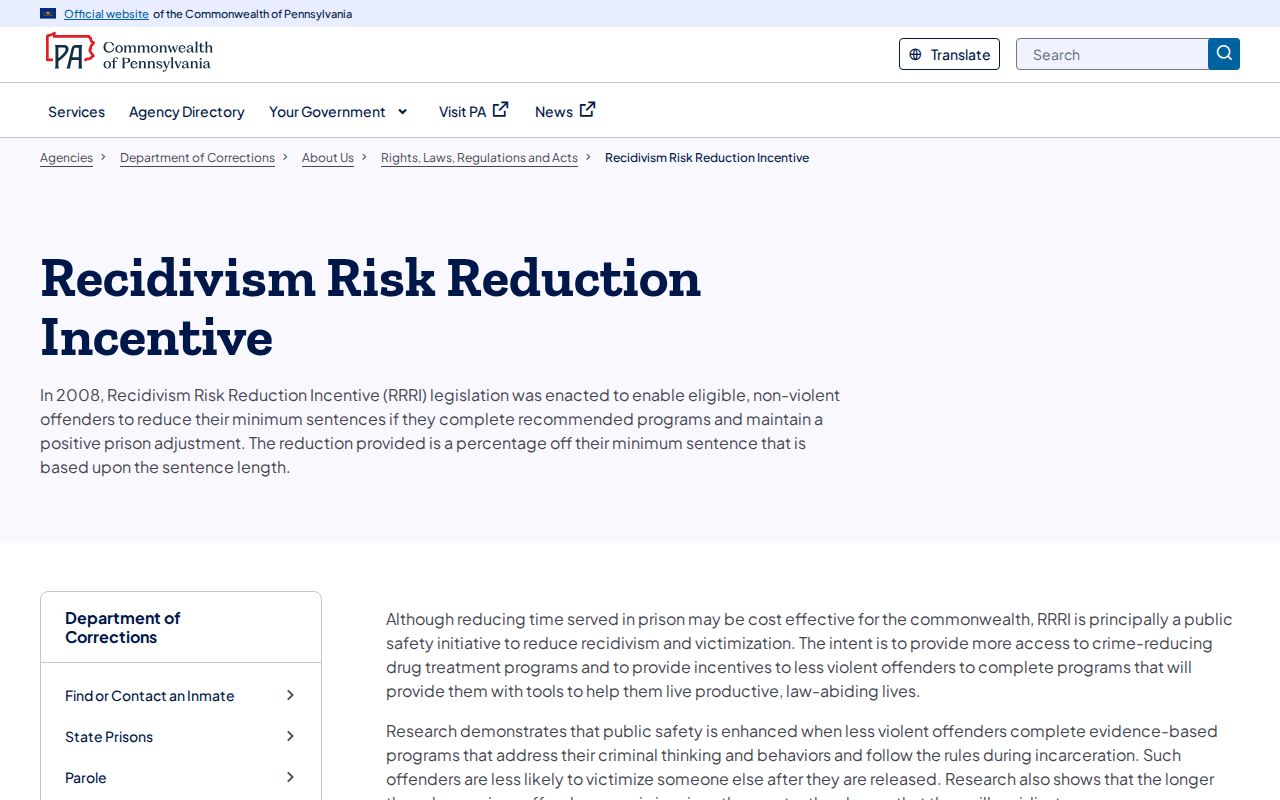
The state description confirms that programming and positive adjustment are part of the process, rather than a simple public release-date calculator.
Eligibility exclusions are detailed. They include specified sentence types, offenses, histories, charges, and conduct. DOC must also make required certifications about assessment, program completion, conduct, reentry planning, and statutory risk findings. An RRRI minimum therefore creates conditional earlier eligibility and still ends in a parole decision. It is not “good-time discharge.”
Why Monroe Release Dates Change
An official date can move when the facts used in the calculation change. Some changes benefit the person, such as properly applied credit for prior confinement. Others can delay community release or route the person into another form of custody. The latest court, DOC, and Board records should be compared rather than using arithmetic based on the arrest date.
| Factor | Possible effect on the date or disposition | Best confirming record |
|---|---|---|
| Credit for time served | Changes the official calculation when credit applies under 42 Pa.C.S. § 9760 | Sentencing order and current agency calculation |
| Consecutive or concurrent terms | Changes how multiple sentence periods combine | Judgment of sentence and DOC computation |
| Amended court order | Corrects or changes a term or credited period | Later docket order |
| RRRI certification | May create an earlier parole-eligibility minimum for an eligible person | Sentence and DOC certification |
| Parole grant or denial | May start release processing or set a later review point | Final Board Action |
| Detainer or other hold | May cause transfer rather than community release | Custody disposition and receiving-agency record |
| Violation or recommitment | Can lead to recalculation and renewed custody | Board violation or revocation decision |
Credit for time served is governed by 42 Pa.C.S. § 9760. Its application is case-specific. Escape time, parole recommitment, sentence aggregation, and other lawful recalculations can also matter. An unofficial calculator cannot resolve those records.
County Versus State Release Dates
At MCCF, the first question is whether the person is awaiting trial, serving a county sentence, or waiting for transfer. A pretrial release may turn on bail or a court order. A county sentence may involve local judicial parole authority. Monroe Public Defender guidance says the county sentencing judge generally controls parole when aggregate maximum sentences are under twenty-four months, while state parole generally controls a maximum of two years or more, subject to a stated exception for some county DUI sentences.
That rule is useful for routing, not calculation. Place of confinement, aggregate terms, the actual sentencing language, and statutory exceptions can change the result. Ask MCCF for the release or transfer disposition. Search both Magisterial District Judge and Common Pleas dockets because the first can show bail and preliminary events while the second can show sentencing and later orders. The Monroe County MDJ administration page explains the local preliminary, bail, and committing functions.
A state-prison case requires the statewide route. Confirm the prison through the inmate locator, obtain the latest sentence-status calculation from PA DOC, and read any final Board Action. If the person is later shown on the Department Supervised Individual side, that current record supports release into community supervision. It does not prove final discharge.
Confirm Monroe County Actual Release
The last step is a dated event from the correct source. For MCCF, request the release or transfer record with the person’s identifiers and a narrow date range. For PA DOC, compare the state custody record, final Board Action, and any matching supervised-individual result. If another agency received the person, follow that custodian because a county departure may be a transfer rather than freedom in the community.
PA SAVIN through VINELink can provide custody-change notifications for participating Pennsylvania county jails, state prisons, and state parole. It is useful for notice, not sentence arithmetic. A missing result does not prove release, and alert timing should not replace the agency record. Registration steps and limits are covered on the Monroe County VINE Inmate Check.
Keep the questions separate. “When might parole become possible?” calls for the sentence minimum and any valid RRRI minimum. “Did release occur?” calls for a dated custody event. “Is supervision over?” calls for a final discharge record. Treating those as three different record checks avoids the most common date error.
Note: Confirm an exact release with the agency record, even when a projected date, review month, or notification points to the same day.